Introduction
Playing solo doesn't mean slow progression. With short goals and clear routines, a solo player can advance steadily and limit burnout.
This guide is independent, written for informational and educational purposes for the Dofus community. It is not affiliated with or endorsed by Ankama Games.
Tips and examples are based on Dofus Unity 2026 and solo play sessions.
Quick summary: optimize your time
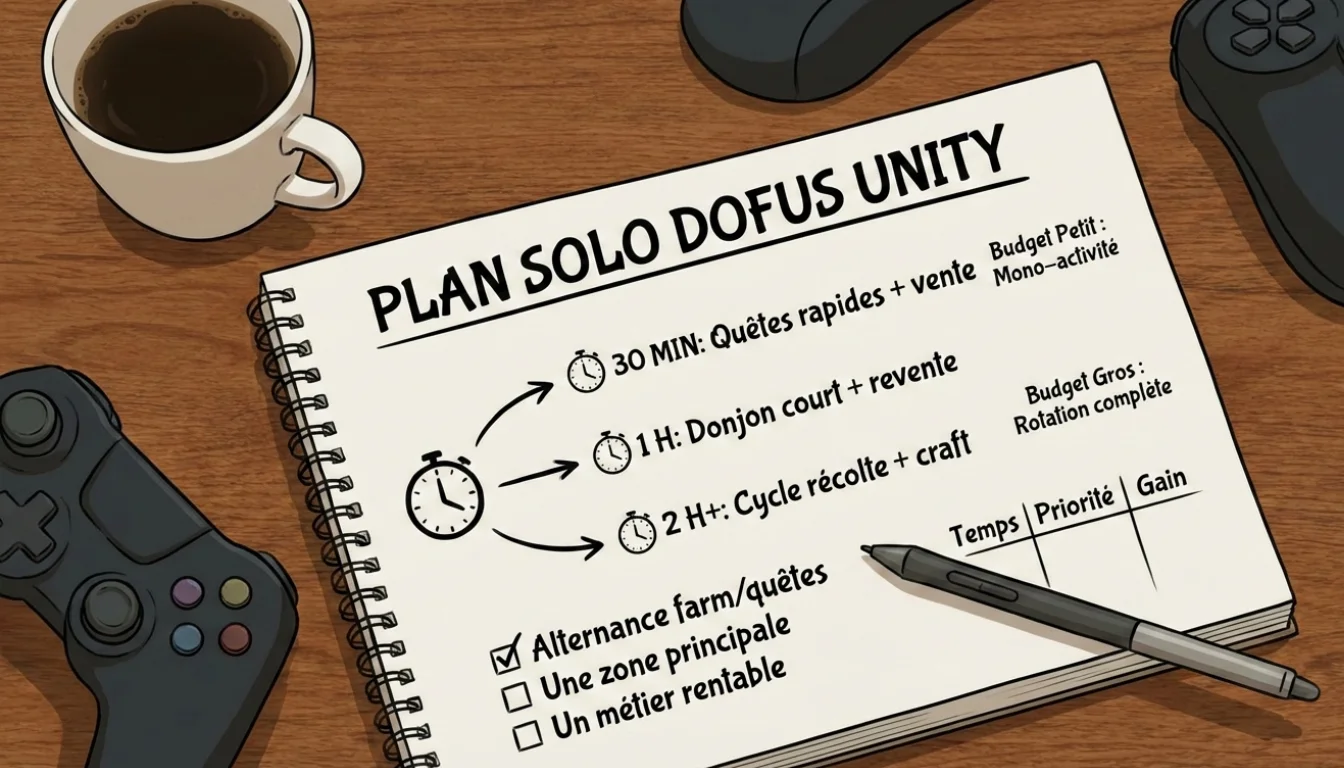
- 30 min: Quick quests + sell
- 1 h: Short dungeon + resale
- 2 h: Gathering + craft cycle
- Low budget: Single activity focus
- High budget: Full rotation
Comparison by available time
| Time | Priority | Gain | Example |
|---|---|---|---|
| 30 min | Quests | Medium | Achievements + sell |
| 1 h | Dungeon | Good | Short run |
| 2 h+ | Full cycle | High | Gathering + craft |
Tools to save time
What endgame players do
Endgame players plan their sessions and favor short but regular rotations.
Prioritize your goals
A short-term goal must be clear: a level, a piece of gear or a profession tier. Avoid overly long plans—they kill motivation.
Progression routines
- Alternate between farm and quests to vary activities.
- Stick to one main zone to limit travel.
- Pick a profitable profession to stabilize kamas income.
Simple planning table
| Session | Goal | Target duration |
|---|---|---|
| Short | Quick farm or easy quest | 20 to 30 minutes |
| Medium | Simple dungeon + craft | 45 to 60 minutes |
| Long | Gear goal | 90 minutes |
Pro tips
When I play solo, I always start with a single goal per session to avoid scattering. I favor short 20-60 minute blocks, with one main activity and a backup activity if the market stalls. I cut anything requiring too much travel and stick to a repetitive routine that produces measurable results each week.
Real experience report (Solo)
Server week from March 17 to 23, 2026: solo, I improved my consistency by reducing my goals and repeating a simple loop: quests, short farm, sell.
What didn't work for me: trying to over-optimize a single long session and ending up with no concrete validation.
What worked for me: chaining multiple mini-sessions with written tracking, then adjusting the routine at weekend.
Advanced Routines for Solo Players
Time is the most valuable resource in the game. A solo player who optimizes every minute of their session progresses faster than someone who plays twice as long without a plan. Here are community-tested and validated routines.
The 30-Minute Routine
If you only have 30 minutes a day, focus on three things: the Almanax offering (2 minutes), listing your crafts/harvests from the previous day (5 minutes), and a single objective (23 minutes). The objective can be a dungeon, a quest, or a targeted gathering session. Don't wander: choose one objective and finish it.
This routine works because it eliminates wasted decision time. Players who log in without a plan often spend 15 minutes staring at their inventory without doing anything productive.
The One-Hour Routine
With an hour, follow the 20-20-20 pattern: 20 minutes of profession gathering (automatic routine, low focus), 20 minutes of progression (quest or dungeon), 20 minutes of management (sales, purchases, inventory organization). This rhythm alternates activities to avoid fatigue and maximizes different revenue types.
Prioritization by Impact
Not all activities are equal in terms of progression per minute. Here's a ranking based on hundreds of hours of testing:
Very high impact: Dofus quests (Dofus items + XP + kamas), Group dungeons with idols (maximum XP), Forgemaging (maximum kamas/hour for experienced players).
High impact: Uncompleted exploration achievements (free XP), Targeted gathering of in-demand resources (regular kamas), Village quests (unlock areas and give XP).
Medium impact: Aimless monster fighting (average XP), Marketplace flipping (requires knowing the market well), Low-level crafting professions (low profit before level 100).
Low impact: Wandering without a goal, comparing equipment without buying, being AFK in town, redoing mastered dungeons without challenges.
The Perfectionist Solo Trap
Many solo players fall into the trap of wanting everything perfect before moving on. They spend hours optimizing level 80 gear when they would progress faster with decent gear and advancing through quests. The 80/20 rule applies perfectly: gear at 80% of its potential is enough to progress. You'll optimize at level 200.
Essential Solo Tools
Solo players need tools to compensate for the lack of a group. The Dafous Almanax reminds you of today's offering and saves time. The Build Generator helps plan equipment tiers without hours on forums. The Ochre Tracker prevents recapturing already-caught monsters. Each tool saves real time, and that time converts directly into pure progression.
FAQ
Q1: Do I need to play every day?
A1: No, consistency matters more than frequency.
Q2: Which profession works best solo?
A2: A simple gathering profession is the most stable.
Overall analysis
Solo progression becomes efficient when each session has a simple goal. The shorter and more repeatable the routines, the more motivation stays stable over time.
Author
Written by Dafous. Dofus player for over 10 years, creator of Dafous.app.
🛠️ Recommended tools
These Dafous tools are a great complement to this guide:
- Smart progression — Plan your leveling path
- Set simulator — Calculate your set bonuses
Join the discussion
Comments are moderated before publication. Your email address is never displayed publicly.