Introduction
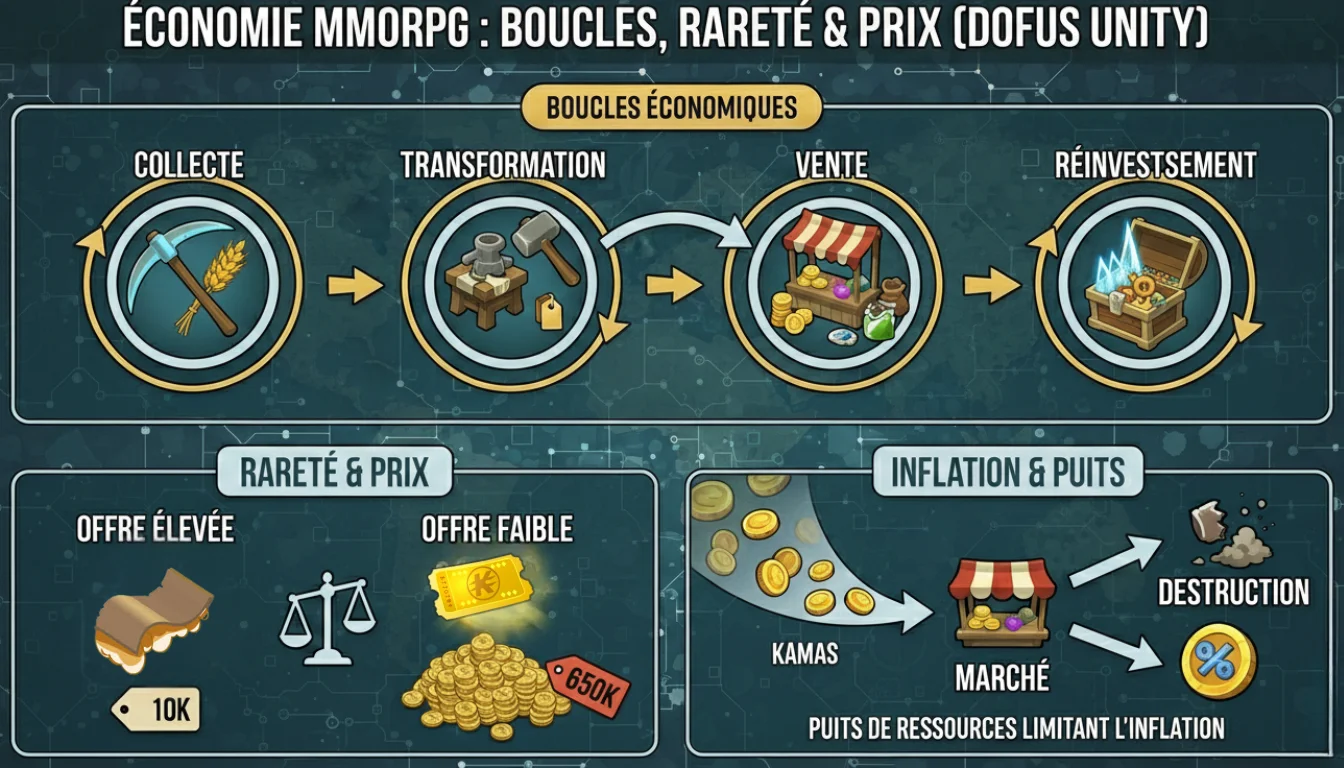
An MMORPG economy runs on simple but powerful loops: gathering, crafting, selling and reinvesting. Understanding these cycles helps you make better decisions and avoid wasteful spending.
This guide is independent, written for informational and educational purposes for the Dofus community. It is not affiliated with or endorsed by Ankama Games.
Observations and examples are based on Dofus Unity 2026 and in-game testing.
Quick summary: how to manage the economy
- Beginner: Stable income, low risk
- Solo: Short repeatable cycles
- Team: Role specialization
- Low budget: Harvesting
- High budget: Measured speculation
Strategy comparison
| Action | Timeframe | Risk | Impact |
|---|---|---|---|
| Harvesting | Short | Low | Stable |
| Crafting | Medium | Medium | Good |
| Speculation | Long | High | High |
Tools to track prices
What endgame players do
Endgame players diversify between harvesting, crafting and quick sales to smooth out fluctuations.
Value creation loops
A raw resource becomes profitable once it's processed. Time invested in gathering converts into value through a profession or a craft. The shorter the chain, the clearer the margin — but the competition is fiercer.
Inflation & resource sinks
Prices rise when the influx of kamas outpaces resource consumption. Destruction sinks like crushing, equipment and taxes limit inflation by removing value from the market.
Scarcity, time & risk
Rare resources have a high price because they combine a low drop rate with combat risk. Farm time is the real currency: the more time a resource costs, the higher its perceived value.
Simple economic levers table
| Lever | Price effect | Dofus example |
|---|---|---|
| Scarcity | Raises price | Boss resources |
| Accessibility | Stabilizes price | Low-level resources |
| Destruction | Reduces inflation | Crushing, taxes |
Applied to Dofus Unity
On Unity, reduced transition times boost productivity. This makes competition fiercer on common resources and shifts value toward crafts and specialized segments.
Pro tips
In my testing, I always start by quantifying my actual time per activity before looking at the listed price. Then I compare the net margin across raw sales, crafting and crushing, and keep the most stable loop over several days. When the market gets too volatile, I reduce volume and prioritize fast rotation.
Real experience report (Economie MMO)
March 10–23, 2026: for me, the same resource showed a margin spread from -12% to +31% depending on how I processed it and the time of sale.
What didn't work for me: stacking a huge stockpile with no exit window. I locked up capital and took a price hit.
What worked for me: splitting into micro-lots, tracking sell speed, and deciding each evening between selling, crafting or short-term holding.
Advanced Dofus Economy Mechanics
The Dofus Unity economy functions like a living ecosystem where every player action influences prices for everyone else. Understanding these mechanics deeply gives you a decisive advantage in generating kamas consistently.
The Supply-Demand Cycle in Practice
When an update adds a new dungeon, the resources from that dungeon are rare and expensive for the first two weeks. Then prices drop as players farm them en masse. This cycle repeats with every patch: if you anticipate market needs before others, you buy low and sell at the peak. That's the foundation of smart flipping.
Concrete example: when the Count Harebourg dungeon was added in Frigost, the Count's Glasses went from 2 million kamas to 400,000 in three weeks. Players who farmed and sold them immediately hit the jackpot.
The Importance of Economic Sinks
An economic sink is any mechanism that removes kamas or items from the game: the marketplace tax (2%), equipment breaking for Forgemaging, purchasing single-use consumables, zaap fees. Without these sinks, inflation would make kamas worthless.
For a savvy player, sinks are also opportunities. Breaking creates constant demand for recyclable equipment, which maintains crafted item prices. Forgemaging consumes runes, which supports their value. If you understand which sinks absorb the most value, you know which markets will stay profitable long-term.
Single-Account vs Multi-Account Servers
The economy differs drastically between server types. On a single-account server, competition for gathering spots is lower, raw resource prices are higher, and group play is essential. On a classic multi-account server, productive players saturate the market faster, margins are thinner, but transaction volume is higher.
Adapt your strategy to your server: check prices on the Dafous Marketplace before starting a craft, because a profitable item on one server can be a loss on another.
Timing and Seasonality
Prices fluctuate by time and day. Weekday mornings are quiet: that's when to buy resources at their lowest prices. Evenings and weekends bring more buyers: that's when to sell. Events like Temporis, in-game festivals, and updates create predictable demand spikes.
The wealthiest players don't go for big gambles. They make dozens of small consistent transactions daily, exploiting these micro-price variations. It's consistency, not risk-taking, that builds a kamas fortune.
FAQ
Q1 : Why do some resources have unstable prices?
A1: Demand shifts with updates, game modes and crafting trends.
Q2: Should you sell raw or process?
A2: Processing often boosts your margin, but takes time and good timing.
Overall analysis
A healthy MMO economy runs on short cycles and active resource sinks. The better you understand time cost, the better you optimize your sales and investments.
Author
Written by Dafous. Dofus player for over 10 years, creator of Dafous.app.
🛠️ Recommended tools
These Dafous tools are a great complement to this guide:
- Set simulator — Calculate your set bonuses
Join the discussion
Comments are moderated before publication. Your email address is never displayed publicly.